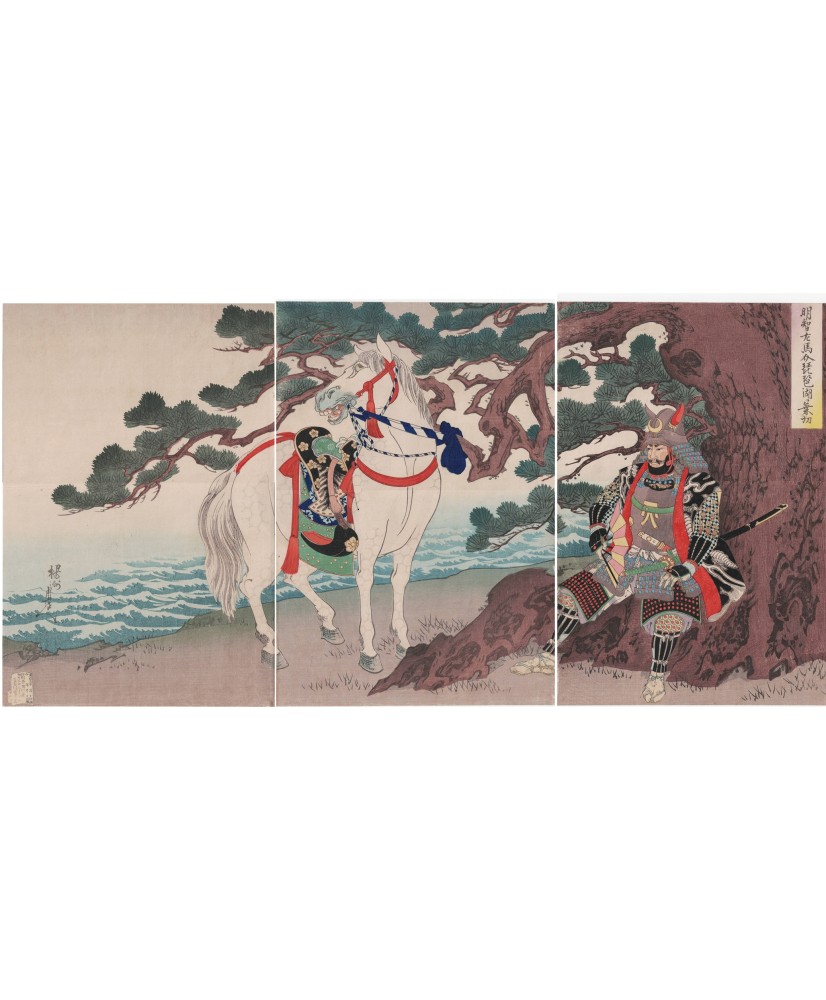
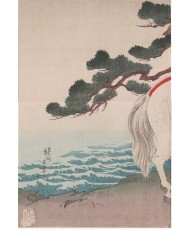
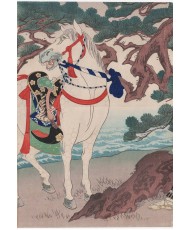
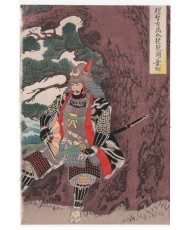
AKECHI Samanosuké 明智左馬之助
A print by 楊洲 周延 Yōshū Chikanobu (1838–1912)
Date of production: Meiji 26 (1893)
AKECHI Samanosuké
On June 2, 1582 (the 10th day of the Tenshō era), Akechi Mitsuhide assassinated his lord, Oda Nobunaga, at Honnō-ji Temple in Kyoto. Upon learning the tragic news of his father-in-law's death, Akechi Samanosuké—who was at Sakamoto Castle, Mitsuhide's main stronghold—crossed Lake Biwa on horseback. A stone monument bearing the inscription "Where Akechi Samanosuké crossed the lake" stands near the Lake Biwa Cultural Center in Uchidehama.
3 sheets, approximately 38 x 25 cm each
Yōshū Chikanobu (1838–1912)
At the age of 15, he studied painting under Kuniyoshi and took the name Yoshitsuru (2nd generation) (the authenticity of works bearing this signature remains uncertain). He became an ukiyo-e print artist under the names Utagawa Yoshitsuru II and others. Finally, following the death of Toyokuni in December 1864, he joined Toyohara Kunichika—a disciple of Toyokuni—and adopted the name Yōshū Chikanobu.
*Ookubi-e* refers to a style of *ukiyo-e* print—primarily produced during the Edo period—that depicts a person's face or bust in close-up.
UKIYO E (Japanese print)
**The horizontal line visible in the image is the result of combining two scanned images; there is no actual line on the print itself.